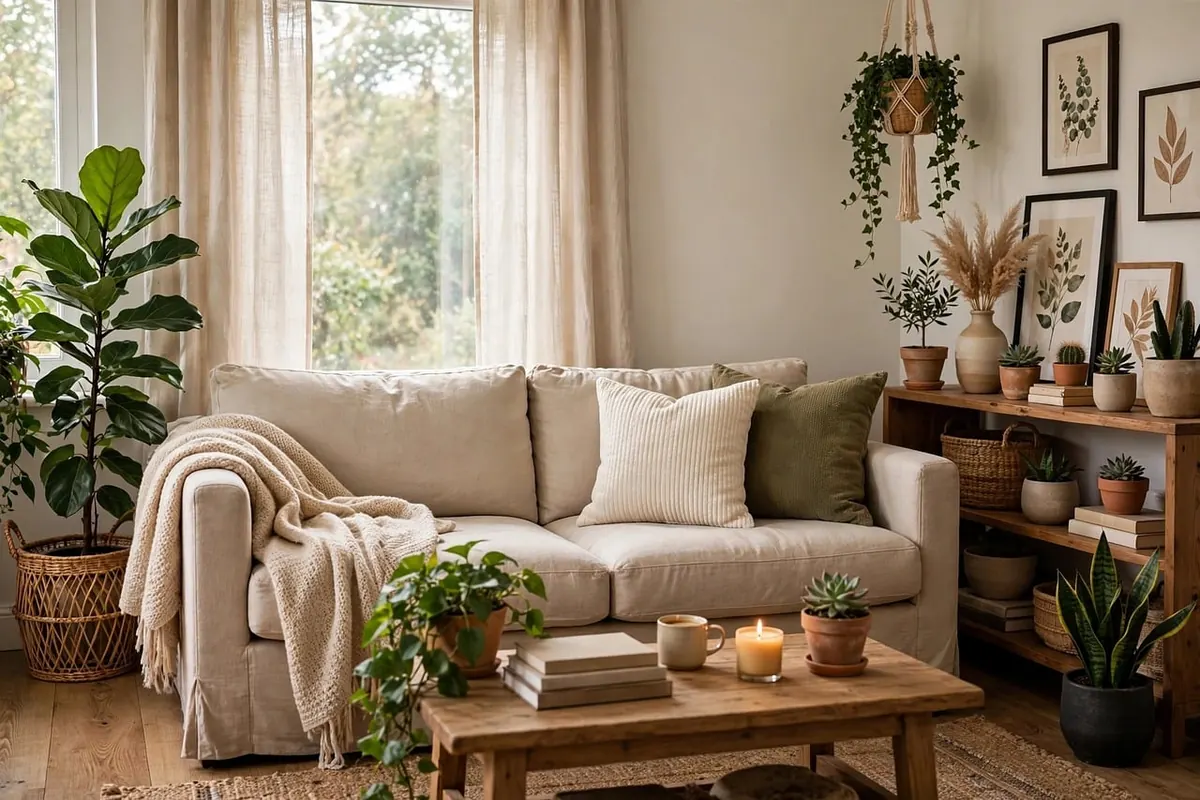
Quiet luxury reached interiors by way of fashion, but it fits British homes unusually well. The idea is simple: a room should feel expensive without announcing it. No monogrammed cushions, no mirrored coffee table, no gold anything. Instead you get proportion, good material and restraint — the decorating equivalent of a well-cut coat in undyed wool.
What follows is what the look actually involves, which materials carry it, and how it differs from the minimalism that dominated British interiors for the best part of two decades.
What quiet luxury actually means
Strip away the label and quiet luxury is a set of decisions about where attention goes. In practice it shows up in three places.
- Material over pattern. The interest in the room comes from texture — chunky wool, slubby linen, hand-thrown ceramic — rather than from a busy print.
- A palette with nothing shouting. Tones sit close together, so the eye travels round the room instead of stopping dead at one wall.
- Comfort that is generous rather than fussy. Deep seats, good curtains, a rug you can actually walk on in socks.
The money goes where your hands and eyes land: the sofa, the door handles, the taps, the bedside light. That is a useful rule, because it means a quiet room does not have to be an expensive one. Painted floorboards, a second-hand oak table and one beautiful lamp will read better than a full suite of new furniture bought in a single afternoon.
The materials that do the talking
If you remember one thing about this look, remember that the materials are the decoration. The ones that work hardest in a British climate are:
- Wool and mohair. Upholstery, throws and stair runners in undyed, heathered or bridle-toned yarns. Wool holds its shape and takes everyday wear well.
- Linen and cotton. Curtains, loose covers and bedding. Linen creases; that is part of the appeal, not a fault.
- Solid timber. Oak, elm and walnut, oiled or waxed rather than lacquered, so they develop a patina instead of a shine.
- Aged and unlacquered metal. Brass door furniture, ironmongery and light fittings that dull down with handling.
- Stone and slate. Honed limestone, marble or slate, kept matt. Polished stone tips a room towards hotel lobby.
- Lime plaster, clay paint and chalky emulsion. Finishes with a little variation in them, which soften our low grey light.
- Natural floor coverings. Sisal, coir, jute and flatweave wool rugs.
What you will not find: high-gloss veneer, acrylic sheen and mirrored surfaces. This is practical as well as aesthetic. Textured, matt finishes hide dust and fingerprints; shiny ones advertise them.
Colour and light
The palette is narrow and warm. Think chalk white, bone, oatmeal, stone, clay and mushroom for the shell, then one or two deeper notes for weight — muted sage, olive, ink blue, oxblood or a soft near-black. Keep the contrast low. If you want a dark accent, use it in a small area such as joinery, a door or a single upholstered chair, and let everything else stay calm.
British light is low and changeable, so never choose paint from a sample card in a shop. Paint a large patch on two walls of the actual room and live with it for a week, looking at it in the morning and again under lamplight.
Lighting matters more here than any single purchase. Warm bulbs, dimmers, and several small pools of light at eye level will do more for a room than a new rug. A grid of cool recessed downlights will flatten even a beautifully finished space, and is the quickest way to make good materials look ordinary.
How quiet luxury differs from minimalism
The two get muddled, but they pull in different directions.
- Minimalism subtracts; quiet luxury layers. A minimal room removes objects. A quiet room can hold books, a worn armchair and family photographs and still feel calm.
- Minimalism tends cool; quiet luxury tends warm. Chrome, glass and bright white, versus brass, timber and lime plaster.
- Minimalism counts things; quiet luxury weighs them. One well-made piece does the work of five.
- Minimalism photographs as a showroom; quiet luxury photographs as a home. It is meant to look better after ten years, not on the day it is finished.
Quiet luxury is not the absence of things. It is the absence of noise.
Neither approach is better. If you love hard edges and empty surfaces, that is a perfectly good way to live. But if a room feels slightly cold and you cannot work out why, adding texture, tone and a softer floor is usually the answer rather than buying another piece of furniture.
Why it suits British houses
Georgian and Victorian rooms already contain much of the work: generous proportions, tall sash windows, cornices, deep skirting and panelled doors. These features need flattering paint, decent curtains and furniture that does not fight them. Quiet luxury asks very little of a period room, which is why it looks settled in them so quickly.
The look also works in a 1930s semi or a new-build flat, though you may need to add the character yourself — a run of simple joinery, a wool runner, a properly lined curtain. What to avoid is pastiche. Reproduction beams and fake panelling read as costume, and quiet luxury is about honest materials rather than a period set.
How to get the look, step by step
- Fix the shell first. Cracked plaster, uneven paint and worn flooring undermine everything else. Deal with these before buying a single cushion.
- Settle on two or three tones. Choose them, write them down, and hold to them across rooms so the house reads as one thought.
- Pick one anchor per room. A sofa, a rug or a painting that the eye rests on — then keep everything else quiet around it.
- Spend on what you touch. Handles, taps, switches, bedding and seating. Nobody notices the cost of a shelf.
- Mix eras and sources. New upholstery with an antique chest, or a modern lamp on an old table. Matching sets look like a showroom.
- Do lighting before accessories. Lamps, dimmers and warm bulbs, then cushions and books if you still need them.
- Edit at the end. Take one thing out of every room. If you miss it, put it back.
The most common mistakes are all beige and no texture, which reads as flat rather than luxurious; cool white bulbs; and buying the look rather than the room — a vast modular sofa that swallows a small Victorian front room will never feel calm, however good the fabric.
Start with one room
Choose the room you use most and give it a proper go. Repair and repaint the shell, decide your palette, pick two honest materials and buy one genuinely good thing, whether that is a wool rug, a linen curtain or a brass door handle you will touch daily. Then stop and live with it for a season.
The second layer — the lamp, the ceramic, the picture — is easier to get right once the bones are right, and it is far cheaper than starting again. Quiet luxury is slow by nature. That is exactly what makes it last.